
Is the Bible Trustworthy?
GotQuestions.org weighs in


I was discussing my most recent post with my mom (She was not a fan of the content, but she thought my writing was ok. Thanks, Mom!) and she suggested GotQuestions.org as a useful source that could help some of my disagreements with Christianity and the Bible. I perused the site for a while, glancing over articles like “What does the Bible say about homosexuality? Is it a sin?” (spoiler alert: it is). I quickly realized that I had no reason to care what a 2000+ year old book or a website explaining it had to say about my sexuality or any other matter unless I had a reason to believe that it was true and accurate. Popping “Bible true” in the search bar, I soon found the article, “Why should I believe the Bible?,” exactly the article I was looking for.
In his opening paragraph, the author makes the claim:
“The importance of the Bible’s message demands it receive fair consideration, and the truthfulness of its message is observable, testable, and able to withstand scrutiny.”
Later they state:
“If, however, the truth claims of the Bible are found true whenever it is possible to test their veracity or are proved true during historical and scientific discovery, then the internal claims of the Bible’s own trustworthiness are more compelling.”
Are We Totally Depraved?
So, let us examine the evidence. Starting off, he dives into the supposedly unique claims of the Bible including:
“The Bible, for instance, teaches that mankind is inherently sinful and deserving of eternal death. If man were responsible for the content of the Bible, the view of humanity would not be so dark—we tend to make ourselves look good. The Bible also teaches that humans can do nothing of themselves to remedy their natural state. This, too, goes against human pride.”
To restate, the Bible is true because humans would not have invented a belief that viewed humanity so negatively. While I am not an expert on world religions, the concept of a sinful humanity is not unique to Christianity. However, even if it were, does being the worldview with the most extreme view of human depravity make that worldview true? If that were the case, I could make up a religion with a harsher view, and that one would now be the true one.
The other problem with this line of reasoning is that we should not necessarily be looking for the worldview with the harshest view of humanity; instead, we should be seeking the worldview with the most accurate view of humanity. The statement that man is “inherently sinful and deserving of eternal death” is, in fact, multiple unsupported claims, the first of which is that sin exists, the second, that we are inherently sinful, and the third, that we deserve eternal death as a punishment. I will focus on the first two because the third is meaningless without them.
To begin, what is sin? According to the article “What is the definition of Sin” on the same site:
“Sin is described in the Bible as transgression of the law of God (1 John 3:4) and rebellion against God.”
According to this definition, if God does not exist, sin also does not exist. Not terribly helpful when one is attempting to determine the existence of God and whether the Bible is true. To help avoid the problem of begging the question, let us substitute evil (meaning “morally reprehensible” or “causing harm”1) for sin, i.e.: “man is inherently evil…” The question we must ask then is, “Are all humans inherently evil?”
Certainly, some people are evil and have caused extreme harm to others. Hitler, Columbus, Genghis Kahn, and others quickly come to mind. However, other examples of individuals doing great good also are readily at hand: Abraham Lincoln, Martin Luther King Jr., and Jonas Salk spring to mind as likely examples. The rest of us exist between the extremes, with incalculably small evils but mostly goods committed every day. It seems that humanity’s evil and goodness exist in a bell curve, with outliers of great evil and great goodness on the wings while the bulk of humanity sits somewhere in the middle. While they may not rise to the level of our greatest heroes, society functions because most people choose to not deliberately harm other people intentionally. The Bible’s claim that all humans are inherently sinful (or evil) does not seem to match up with the observed reality of human nature.
The argument that people would not invent such a harsh description of human nature fails on another level. This picture of people’s humanity is exactly the technique a successful religion or cult might implement. The tactic of degrading a person’s self-image and creating a feeling of dependence is a classic method of manipulation and control. If you can make someone believe that they have failed and nothing they do is good enough, and then add in that your teachings are the only way to fix said worthlessness, you have them under your control. This is called “guilt tripping,” and it is used by everyone from abusive spouses to cult leaders. Christianity’s declaration that you are a worthless sinner is an effective use of this technique. It leaves adherents with no sense of personal dignity or worth as everything good about them comes from Christ. While the “total depravity” doctrine does not support the Bible’s veracity, it does provide a likely explanation for why the religion has been so successful in making and keeping converts.
Biblical Consistency?
The next line of reasoning is the claim that the various books of the Bible, though they are from vastly different periods and authors, have a unifying theme and message that binds them together:
“The unity of the biblical message is further reason for why one should believe the Bible. The Bible was written over a period of approximately 1,550 years, with at least 40 human writers, most of whom did not know each other and were from varying backgrounds (king, fisherman, tax collector, shepherd, etc.). The Bible was written in various environments (desert, prison, royal court, etc.). Three different languages were used to write the Bible, and, despite covering controversial subjects, it carries one harmonious message. The circumstances surrounding the writing of the Bible would seem to guarantee its fallibility, and, yet, the message from Genesis to Revelation is uncannily consistent.”
This claim is difficult to evaluate, to say the least. “Harmonious message” is a highly subjective idea; what satisfies one reader’s expectation of harmony will differ vastly from another’s. However, we can attempt to begin by examining various sub-themes or questions and see if the Bible has consistent answers throughout. One of these questions is: “Why do we suffer?”
Bart Ehrman, in his book, “God’s Problem” thoroughly explores this question. He demonstrates that the Bible’s various authors had widely differing answers (sometimes within the same book) to this core question about our world.
The Prophets: Suffering is God’s punishment for disobedience.
Job: Suffering is a test from God. Also, it is inexplicable and questioning God about it is arrogant.
Ecclesiastes: Suffering is an inexplicable and natural part of life.
Jesus and apocalyptic writers: Suffering is the result of Satan and evil spirits ruling the world, to be soon corrected by the coming judgement.
All these sources differ widely on what is one of the most fundamental of questions. At least on this topic, the Biblical authors lack a consistent understanding of the world.
While many of the themes of the New Testament do continue those found in the Old (unsurprising, considering that its authors were intentionally weaving their message into that of the Old Testament), much of the New Testament is a radical departure. The NT adds concepts such as hell, heaven, Satan (in his Christian form as a fallen angel and the primary antagonist of God), abandonment of the Law, and more that were never (and still are not) a part of Jewish theology. While some of these could be explained as a part of the new covenant and others are retroactively read into the Old Testament text, many seem strange, like why would God not clearly warn his people of the primary enemy of humanity, Satan, until well over two-thirds into the text and many hundreds of years into their history? It seems more likely that the idea of Satan was a later addition to Jewish theology that was incorporated into the Christian message. Regardless of their origin, these conflicting ideas cast doubt on the claim that the Bible is consistent throughout.
Beyond theological themes, the Bible also often disagrees with itself when it describes the same events multiple times as in the Gospels. For example, let us review the story of Jesus being born in Bethlehem and the sequence of events after his birth as described in Matthew and Luke.
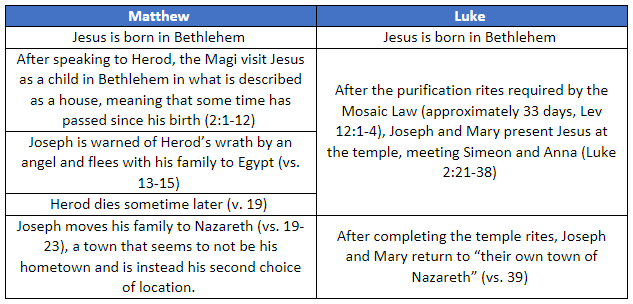
These timelines differ radically in their sequence of events, so much so that it is hard to imagine a way they could be harmonized. This is far from the only instance of the Bible contradicting itself. Other examples include:
The number of animals Jesus rode on during his triumphal entry:
Matthew says two, a donkey and its colt (21:2); Mark, Luke, and John (11:2, 19:29, and 12:14 respectively) say a single animal.
Whether God is all-powerful or not:
Matthew 19:26 says:
“...with God all things are possible.”,
but Judges 1:19 says
“…The LORD was with Judah; and he drove out the inhabitants of the mountain; but could not drive out the inhabitants of the valley, because they had chariots of iron.”
Even if one could devise explanations for all these contradictions, it seems strange that the supposedly “perfect word of God” cannot meet the most basic expectations of factual consistency without help from apologists creating explanations retroactively. It would seem like the “word of God” is unable to stand on its own merits without the efforts of apologists to prop it up.
Scientific and Historical Accuracy
The article then moves on to claim that the Bible is true because it harmonizes with scientific and historical knowledge. The author references two concepts, the hydrological cycle and misguided medical treatment, bleeding2. While they do not cite which Biblical book refers to the hydrological cycle, Creation.com claims that Job describes the cycle in detail. Below are the verses they reference:
“He wraps up the waters in his clouds, yet the clouds do not burst under their weight” (Job 26:8).
“He draws up the drops of water, which distil as rain to the streams; the clouds pour down their moisture and abundant showers fall on mankind” (Job 36:27–28).
“Do you know the laws of the heavens? Can you set up God’s dominion over the earth? Can you raise your voice to the clouds and cover yourself with a flood of water?” (Job 38:33–34).
“Who has the wisdom to count the clouds? Who can tip over the water jars of the heavens?” (Job 38:37).
“… when he made a decree for the rain and a path for the thunderstorm” (Job 28:26).
Ignoring the poetic reference to “the water jars of the heavens,” it is quickly apparent that none of the observations in Job would be extraordinary for an agricultural society whose very survival depended on the vagaries of the weather. Clouds grow and then drop rain, and rain becomes streams. These ideas are just human observations, nothing more or less.
The same thing is true of the idea, not that bloodletting was a bad idea, but that “the life of a creature is in the blood.” First, it is not even a true statement. Though an animal will certainly die without blood (at least until we invent artificial blood) their actual life is not “in the blood;” we know now that life is a chemical process occurring in every cell of a creature’s body. But even accepting the metaphorical meaning of “life” in this case, the observation that an animal or human who bleeds out dies hardly necessitates divine revelation, particularly for a culture where slaughtering animals was a regular task.
Finally, the author claims the historical accuracy of the Bible demonstrates its veracity, using the example of the Bible referencing the Hittite tribe while archeological evidence would not confirm their existence until 1876 (While I am not certain on the truth of this date as the author does not cite their non-Biblical sources). However, even assuming that the date is accurate, the fact that the Bible gets some historical facts correct does not mean that it is completely accurate. The existence of New York City does not confirm that Spider-Man is real. That Abraham Lincoln was a person does not make “Abraham Lincoln: Vampire Hunter” a documentary. It makes sense that a document written about events set in a certain time and place would reference people, places, and ideas relevant to that time and place. It does not mean we can assume that the supernatural (or even basic historical details) are accurate as well.
The bigger problem is that the Bible frequently gets confirmed historical facts wrong. One of these is the census described in Luke 2:1. The first issue with the census is that not only is there no record of an Empire-wide census like that described (in a culture fastidious about its record-keeping about an event whose only purpose would be to create records) but also such a census, one which required men to return to the hometown of their ancient ancestors, would be enormously disruptive to the empire-wide economy and completely pointless, as the purpose of a census is to determine information about where the population currently lives, not where some ancestor lived. Such an undertaking would be completely absurd.
Secondly, the timing of the census and thus Jesus’ birth as described in the various Gospels irreconcilably disagrees with the known historical record. In Luke, the census is said to occur when Quirinius is Governor of Syria, while in Matthew, Herod the Great is said to be in power. The problem with this is that Herod the Great is known to have died in 4 BCE while Quirinius did not become governor until ten years later in 6 CE3 meaning that there is some error in the timing described for Jesus’ birth. The likely explanation is that one of the Gospel writers made an error in the composition of his story; however, if the Bible cannot be trusted to get historical details correct, its trustworthiness on other matters is called into question.
Conclusion
While GotQuestions.org does attempt to make an argument for the trustworthiness of the Bible, it fails to convince on multiple fronts. Without a solid belief in the inerrancy of the Bible, as they claim, their other claims which rely on that assumption fall flat. Christian apologists frequently make broad and confident assertions about the evidence for their claims; however, these often, as we have seen above, fall short of surviving examination. If the Bible is true, it should be easy to prove; the reality that so many apologists reuse such weak arguments seems to cast doubt on their claims.
https://www.merriam-webster.com/dictionary/evil
It is interesting that the author selects scientific discoveries that are hundreds of years old and neglects to discuss differences between the Bible’s understandings of biology, cosmology, and geology vs the current state of the art.
https://bam.sites.uiowa.edu/faq/can-you-explain-problem-census-gospel-luke